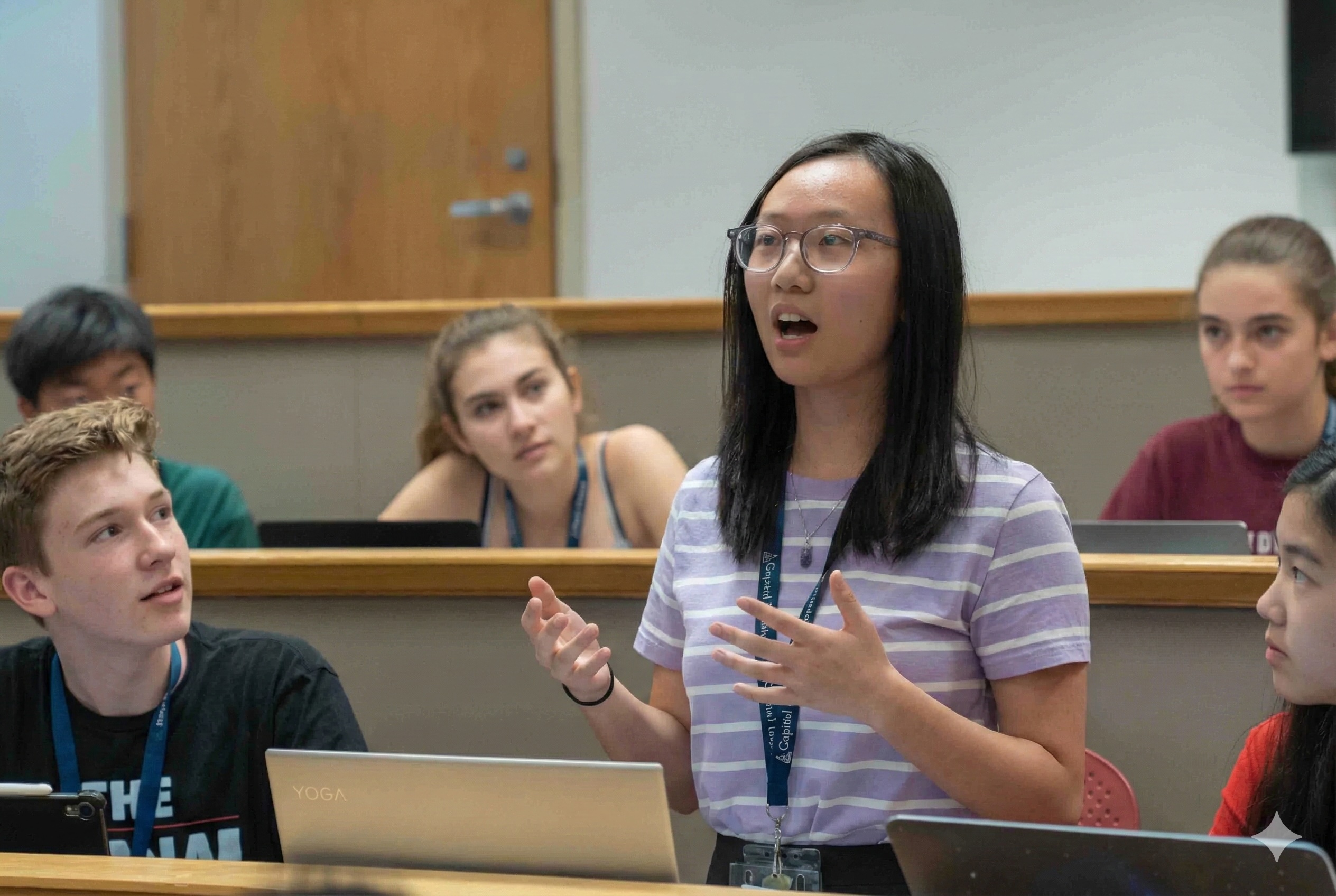
Experienced classroom teachers and debate coaches guide students in public speaking, argument building, and persuasive communication. Practical instruction helps students put each skill into practice.
Assessment and appropriate class placement help identify where your child can grow. Guided practice, individual feedback, and learning tools support progress at each learning level.
10,000+ Students. 35+ Countries. Since 2006, Capitol Debate has helped young people develop confidence through public speaking and debate. Explore parent experiences and alumni stories to meet the people behind our history.
Give your child practice expressing ideas clearly in class and beyond.
1Classroom participation
2Confident presentations
3Responding to questions
Build Skills for Academic Success
Develop the reading, reasoning, and argument-building skills students use throughout school.
1Classroom Confidence Participate more effectively in school
2Test Score Gains Develop skills that improve SAT/ACT performance
3Stand Out to Admissions Build skills college admissions officers rank highest
Stand Out for College and Beyond
Begin building communication, leadership, and intellectual engagement through debate and continued participation.
1Pursue a meaningful interest
2Collaborate and lead
3Explain ideas persuasively
Explore the research behind debate
Academic skills and test performance: A 2021 Houston study found an association between high school debate participation and higher GPA and SAT scores after accounting for measured differences between students. A Chicago study linked school debate participation with ACT college-readiness benchmarks.
College preparation:Stanford’s admissions guidance describes the value of depth in extracurricular activities. Debate offers one way to pursue an interest and develop communication and leadership skills through sustained involvement.
These studies examined school debate programs, not Capitol Debate summer camps. They do not establish that attending a camp causes higher test scores or admission to a particular college. Individual experiences and outcomes vary.
Ready to give your child the confidence to succeed?
Our expert coaches will assess your child's current abilities and create a personalized development plan
Don't Take Our Word For It
Three families.Three stories.Three transformations.
LD
Liam D.
Parent of Charlie D.
Chester Springs, PA
American University & Villanova (CIT)
Video Testimonial
★★★★★
"Watching Him Flourish"
The emphasis on individual growth—not just debate skills—has been impressive. Charlie's critical thinking and ability to articulate his points has improved tremendously.
NS
Neel S.
Parent of Elina S.
Austin, TX
UCLA & University of San Diego
Video Testimonial
★★★★★
"Sign Me Up for Next Year"
On the last day of camp, she said 'you need to sign me up for next year'—and that's what we did. The team is invested in your child's success.
CL
Christel L.
Parent of Lily L.
Berea, KY
UNC Chapel Hill & Hun School
Video Testimonial
★★★★★
"She Was Safe and She Felt Safe"
We sent our 11-year-old eight hours from home for twelve days. Safety was our priority—and Capitol Debate truly goes the extra mile.
Yes. No debate experience is required. Supportive teachers, an individualized action plan, and small-group coaching help students build confidence, organize their ideas, and practice speaking.
Will this help my child feel more confident speaking?
Building speaking confidence is central to Capitol Debate. Students practice delivering speeches, answering questions, and sharing ideas, with constructive feedback that helps them prepare for classroom presentations, interviews, and everyday conversations.
What will my child learn at debate camp?
Students develop public speaking, research, critical thinking, and persuasive communication skills. They learn to organize a speech, support an argument with evidence, respond to questions, and express disagreement respectfully.
What ages can attend Capitol Debate camps?
Most main summer camps serve students ages 10–17. Rookie Camp offers a playful introduction for ages 8–9 at select locations. Age requirements vary by campus, so check your preferred location.
How does my child receive personal attention?
Every student receives an individualized action plan. In Skill Labs of 4–6 students, coaches target specific areas for growth—from speaking confidently to strengthening arguments and improving delivery. Students are also grouped with peers close to their age.
Can students attend overnight or come home each day?
Depending on the campus, students can choose residential or commuter camp. Residential tuition includes housing, meals, evening activities, and staff supervision. Commuters receive the core instruction and return home each evening.
How are residential campers supervised?
Capitol Debate provides 24/7 staff supervision for residential campers. Staff stay in the dorms, supervise activities, and conduct room checks. Families receive campus-specific arrival instructions and staff contact information before camp.
Is debate camp also fun?
Yes—this is summer camp, not summer school. Alongside speaking and debate practice, campers build friendships through team activities. Residential campers also enjoy evening programming such as games, trivia, and talent shows.